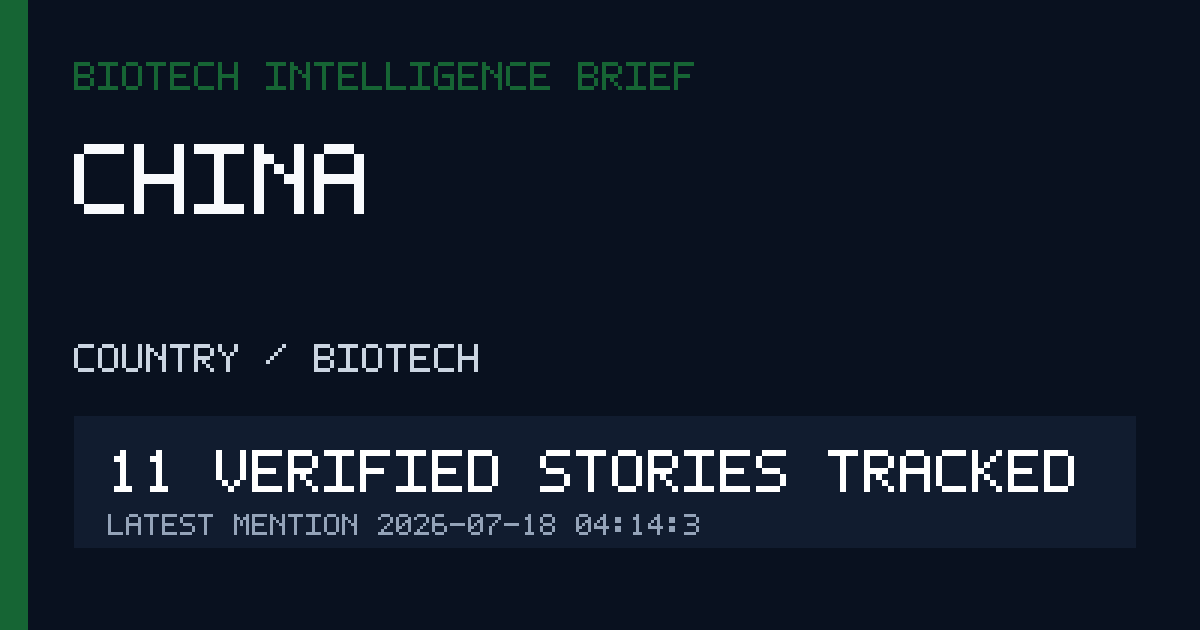
pharma accounts for 10 of the 11 tracked stories, while 1 other category carries the remainder. National Medical Products Administration (NMPA) is the most frequent co-covered peer, appearing in 4 of the 11 tracked stories. Sentiment skews less negative than the wider beat, at 18% negative against 19% across all 366 Biotech stories in the same window.
Figures are computed live from our source-verified story record
— see our methodology for how impact and
sentiment are derived.
What the coverage shows about China
pharma accounts for 10 of the 11 tracked stories, while 1 other category carries the remainder. National Medical Products Administration (NMPA) is the most frequent co-covered peer, appearing in 4 of the 11 tracked stories. Sentiment skews less negative than the wider beat, at 18% negative against 19% across all 366 Biotech stories in the same window. That works out to roughly 0.6 stories per week across a 128-day span. The busiest single day carried 2. Each story carries 2.9 original sources on average, compared with 3.6 for the broader beat in this window. The 7.2 average consequence score is above the beat benchmark of 6.3 in the same window. This profile follows 11 Biotech stories mentioning China across the period from March 7, 2026 to July 12, 2026.
Stories tracked
11
Per week
0.6
Negative
18%
Sources per story
2.9
Computed from the 11 stories linked to this entity, with beat comparisons drawn from all 366 Biotech stories published in the same date window. Shares are omitted below five stories and comparisons below a twenty-story baseline.
Coverage cohort
Appears alongside
Other entities that clear the same relevance threshold in stories also covering China. Shared-story counts are live from our verified record — not editorial picks.
75 healthcare workers infected with the Ebola Bundibugyo strain in DRC expose critical gaps in vaccine coverage and trial infrastructure, pressuring biopharma to accelerate strain-specific countermeasures.
HHS Secretary Kennedy warns that Chinese companies accounted for nearly half of global pharmaceutical licensing deals in 2025, prompting FDA actions to streamline early-stage trials and potentially reduce drug development times by 6 to 12 months. The shift could reshape US biotech competitiveness and investment returns.
Biotech and pharma sectors face supply chain risks from the West Asia situation, but the Indian government claims a multi-pronged strategy will prevent shortages. While concrete fertilizer diversification details are given, pharma-specific mitigation remains less specific, though close monitoring is emphasized.
China is strategically positioning its southern border regions as a digital gateway to export medical AI technologies to the ASEAN region. This initiative leverages advanced infrastructure and geographic proximity to provide scalable, AI-driven healthcare solutions across Southeast Asia.
President Xi Jinping’s 15th Five-Year Plan (2026-2030) positions biotechnology as a cornerstone of "New Quality Productive Forces," prioritizing domestic innovation and supply chain self-sufficiency. This strategic shift aims to decouple China’s life sciences sector from Western dependencies while accelerating the commercialization of cell and gene therapies.
China's launch of its 15th Five-Year Roadmap has triggered a strategic shift in foreign investment toward high-tech sectors, with biotechnology emerging as a primary beneficiary. Global pharmaceutical giants and venture funds are recalibrating their portfolios to align with Beijing’s 'New Quality Productive Forces' initiative.
Muhammad Jalal, a Pakistani researcher at Anhui Agricultural University, exemplifies the growing scientific collaboration between China and Pakistan. This trend highlights China's emergence as a global biotech R&D hub and its strategic efforts to cultivate international talent through the Belt and Road Initiative.
China’s latest strategic roadmap shifts from a 'catch-up' posture to a mandate for global leadership in frontier technologies. This pivot places biotechnology and genomic medicine at the center of national security and economic growth, challenging decades of U.S. dominance in drug innovation.
A new Morgan Stanley report identifies 'affordability politics' as a primary risk for the pharmaceutical sector ahead of the 2026 midterm elections. The firm warns that targeted legislative measures to lower prescription drug costs could create significant pricing pressure on high-margin brand-name drugs.
China has officially signaled a shift toward total technological self-reliance in its 15th Five-Year Plan, prioritizing the domestic life sciences and pharmaceutical sectors. This strategic pivot aims to insulate China’s healthcare infrastructure from global supply chain volatility and geopolitical pressures while fostering a homegrown innovation ecosystem.
China has detailed a comprehensive 2026 policy framework aimed at accelerating domestic biotech innovation while expanding international market access. The initiative prioritizes 'new quality productive forces' in drug development and streamlines regulatory pathways for global pharmaceutical collaborations.
China is linked from 11 stories on this site, each scored at or above our 35% relevance threshold — see how these pages are built.
See something wrong on this page — a misattributed entity, a wrong stat, a broken source
link? Report a data issue.