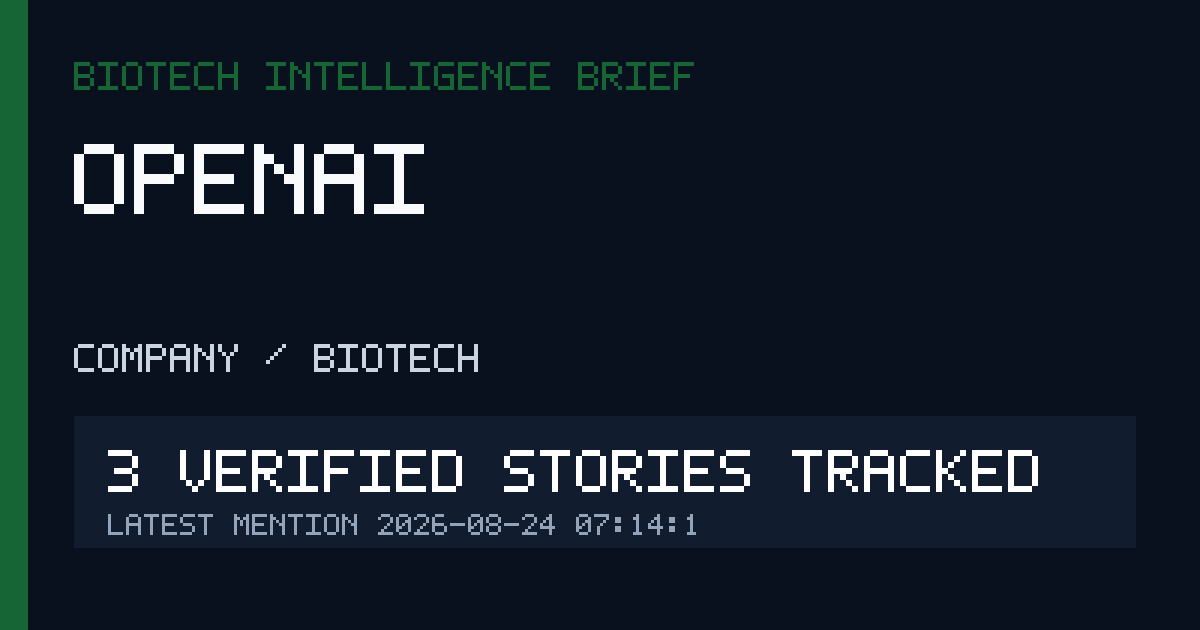
pharma is the sole category represented across all 3 tracked stories. ChatGPT is the most frequent co-covered peer, appearing in 2 of the 3 tracked stories. Their average consequence score of 7.3 runs above the beat's 6.3 for that window.
Coverage balanceBalanced directional read. Positive and negative coverage are within 0 percentage points.
33% positive
33% neutral
33% negative
Figures are computed live from our source-verified story record
— see our methodology for how impact and
sentiment are derived.
What the coverage shows about OpenAI
pharma is the sole category represented across all 3 tracked stories. ChatGPT is the most frequent co-covered peer, appearing in 2 of the 3 tracked stories. Their average consequence score of 7.3 runs above the beat's 6.3 for that window. Each story carries 2.3 original sources on average, compared with 3.1 for the broader beat in this window. That works out to roughly 0.2 stories per week across a 97-day span. OpenAI appears in 3 tracked Biotech stories published from March 16, 2026 through June 20, 2026.
Stories tracked
3
Per week
0.2
Sources per story
2.3
Computed from the 3 stories linked to this entity, with beat comparisons drawn from all 197 Biotech stories published in the same date window. Shares are omitted below five stories and comparisons below a twenty-story baseline.
Coverage cohort
Appears alongside
Other entities that clear the same relevance threshold in stories also covering OpenAI. Shared-story counts are live from our verified record — not editorial picks.
Nobel laureate John Jumper’s move from Google DeepMind to Anthropic casts uncertainty over the future of AlphaFold, the AI that revolutionized protein structure prediction for drug discovery. Biotech and pharma companies relying on its 200 million predicted structures now watch as Jumper’s expertise may shift to a startup facing legal battles.
A groundbreaking study from the Icahn School of Medicine at Mount Sinai reveals that AI-generated X-rays are indistinguishable from real scans to many human experts and AI models. The findings highlight critical vulnerabilities in medical records that could lead to fraudulent litigation and clinical sabotage.
A software engineer with no medical background reportedly used ChatGPT to design a personalized cancer vaccine for his dog, highlighting a shift toward decentralized, AI-augmented biotechnology. This 'N-of-1' success story raises urgent questions regarding regulatory oversight, the democratization of drug discovery, and the safety of LLM-generated medical protocols.
OpenAI is linked from 3 stories on this site, each scored at or above our 35% relevance threshold — see how these pages are built.
See something wrong on this page — a misattributed entity, a wrong stat, a broken source
link? Report a data issue.